Showing posts with label Childhood. Show all posts

Thursday, March 15, 2012

The Magic Of Poetry

A Pandora's box of poetry

If The Story Of Mankind introduced me to history, and if As I Walked Out One Midsummer Morning revealed the delights of long distance walking, then Louis Untermeyer's Golden Treasury opened up a magical world of poetry. I found this book in my stocking one Christmas and was immediately entranced. Although my parents used to lull me to sleep at night with stories and poems, although I was used to seeing poetry books around the house — Robert Louis Stevenson's A Child's Garden Of Verses, AA Milne's When We Were Very Young, John Betjemen's Collected Poems — it was this book which really stirred my imagination, awakening a love of words and rhyme and rhythm and illustration which has continued to the present day. Who could not possibly be charmed by this lovable doggy poem by Ogden Nash?

Doggy poems: click to enlarge

Or fail to be moved by Elizabeth Bishop's fish with "his brown skin hung in strips like ancient wallpaper" and by the boat's engine oil spreading out "until everything was rainbow, rainbow, rainbow"?

Fish poem: click to enlarge

Or startled by Emily Dickinson's original and lovely way of seeing?

I'll tell you how the sun rose —
A ribbon at a time.
The steeples swam in amethyst,
The news like squirrels ran.

The hills untied their bonnets,
The bobolinks begun.
Then I said softly to myself,
"That must have been the sun!"

But how he set, I know not.
There seemed a purple stile
Which little yellow boys and girls
Were climbing all the while

Till when they reached the other side,
A dominie in gray
Put gently up the evening bars,
And led the flock away.

And this description of fog by Carl Sandburg is pure perfection:

The fog comes
on little cat feet.
It sits looking

over harbour and city
on silent haunches
and then moves on.

Endpapers illustrated by Joan Walsh Anglund

Tuesday, March 13, 2012

The Story Of Mankind

There are certain books encountered in childhood which accompany you all your life. One of my own such seminal books was The Story Of Mankind by Dutch-American historian Hendrik van Loon. In fact I'm reading it again at the moment.


It's a children's history book, nearly five hundred pages long and of ambitious scope, charting the history of the world from the formation of planet Earth ("In the beginning, the planet upon which we live was, as far as we now know, a large ball of flaming matter, a tiny cloud of smoke in the endless ocean of space") to the First World War (the book was published in 1921). My copy is the 1922 Harrap edition, printed on thick, yellowing paper, with blue, gold-blocked boards and a rough-trimmed fore-edge. It's illustrated with the author's own crude but rather sweet maps and drawings. After the Foreward and Contents pages, and a "List Of Pictures And Animated Maps", the book begins like this:


"High up in the North in the land called Svithjod, there stands a rock. It is a hundred miles high and a hundred miles wide. Once every thousand years a little bird comes to this rock to sharpen its beak. When the rock has thus been worn away, then a single day of eternity will have gone by."
I used to think this imaginative attempt to visually describe eternity and the vastness of time was incredibly humbling, awe-inspiring and mind-expanding — and still do. I still contemplate these four, simple sentences with a feeling of wonder. They are clear and vivid, but describe something mysterious and almost ungraspable. They have the quality of an ancient myth or fable.

Near the end of the book, on page 466, just before strip diagrams of "An Animated Chronology 500,000 B.C. — A.D. 1922" and "An Historical Reading List For Children", you find "these wise words of a very great Frenchman" (the Frenchman is Anatole France):  


"Irony and Pity are both of good counsel; the first with her smiles makes life agreeable; the other sanctifies it with her tears."

Saturday, March 10, 2012

First Light

One of the loveliest evocations of a country childhood ever written is Laurie Lee's 1959 memoir, Cider With Rosie. The book begins with this brilliant description of lostness and aliveness:

First Light

I was set down from the carrier's cart at the age of three; and there with a sense of bewilderment and terror my life in the village began.

The June grass, amongst which I stood, was taller than I was, and I wept. I had never been so close to grass before. It towered above me and all around me, each blade tattooed with tiger-skins of sunlight. It was knife-edged, dark, and a wicked green, thick as a forest and alive with grasshoppers that chirped and chattered and leapt through the air like monkeys.

I was lost and didn't know where to move. A tropic heat oozed up from the ground, rank with sharp odours of roots and nettles. Snow-clouds of elder-blossom banked in the sky, showering upon me the fumes and flakes of their sweet and giddy suffocation. High overhead ran frenzied larks, screaming, as though the sky were tearing apart.

For the first time in my life I was out of sight of humans. For the first time in my life I was alone in a world whose behaviour I could neither predict nor fathom: a world of birds that squealed, of plants that stank, of insects that sprang about without warning. I was lost and I did not expect to be found again. I put back my head and howled, and the sun hit me smartly on the face, like a bully.

Thursday, March 8, 2012

Beginnings

We shall not cease from exploration / And the end of all our exploring / Will be to arrive where we started / And know the place for the first time. / Through the unknown, remembered gate / When the last of earth left to discover / Is that which was the beginning . . . TS ELIOT Four Quartets: Little Gidding

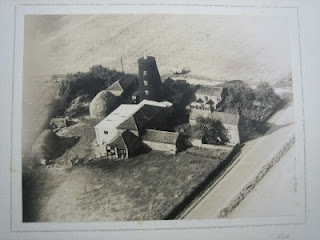
Burnham Mill in 1947

I was born on 13 November 1954 in a remote and obscure corner of Lincolnshire called The Isle of Axholme. Before the Dutch engineer Cornelius Vermuyden drained the area in the early seventeenth century, the wild and inbred natives clustered in low hilltop settlements on an archipelago of small islands surrounded by bog and fen. Even when I was growing up there in the 1950s and 60s, there was still a strong feeling of isolation and apartness. And you couldn't get more isolated than my childhood home. Burnham Mill stood on its own on the high ground between the hamlet of Burnham and the village of Haxey — many miles from the nearest town, Gainsborough, where I later went to grammar school. My father was the miller, my mother did the bookkeeping, and my father's unmarried sister lived in the mill house and kept pigs and chickens and a small herd of Jersey cows.

So, as you can see, I had a rural childhood. Because I grew up in such a lonely spot, I was used to my own company, and would quite happily entertain myself for days on end — walking the fields, watching birds, reading voraciously, writing poems, banging a tennis ball against the brick outhouse wall. I was independent, but did have a small and valued circle of mates (I always preferred a few, close friends to a knockabout crowd, and still do to this day). With my pals I did all the things that country-bred boys did then: climbed trees, made dens in the woods, went birds' nesting, fished the lakes without a permit, camped in the summer, biked everywhere — and later fantasised about taking girls (that strange and exotic species) into the long grass of the overgrown, disused railway embankment. Though what we would have done with them there I don't think we had the faintest idea.

This all sounds idyllic, and, looking back, to some extent it was. However, above the sun-kissed cornfields and red pantile cottage roofs of my country childhood, dark clouds permanently drifted. An authoritarian and manically religious father had brought about in me vague feelings of fear and guilt which were almost paralysing at times. And I was also stricken with an acute self-consciousness which took many years to subside. Nevertheless, by my mid to late teens I was growing into myself, becoming a lot more confident — and getting ready to rock and roll.